Tolkien’s Desk up for Auction
J.R.R. Tolkien’s Legendary Merton College Desk Comes to Auction at Christie’s
Every so often, an artifact surfaces that feels less like furniture and more like an anchor to history—a tangible witness to the creation of worlds. This month, Christie’s is offering exactly such an item: J.R.R. Tolkien’s Merton College roll-top desk, the very workspace at which the author revised The Lord of the Rings and shaped some of his later works. Estimated at £50,000–£80,000, this remarkable desk is one of the most significant Tolkien-related pieces ever to appear on the market.
A Desk That Sat at the Heart of Middle-earth
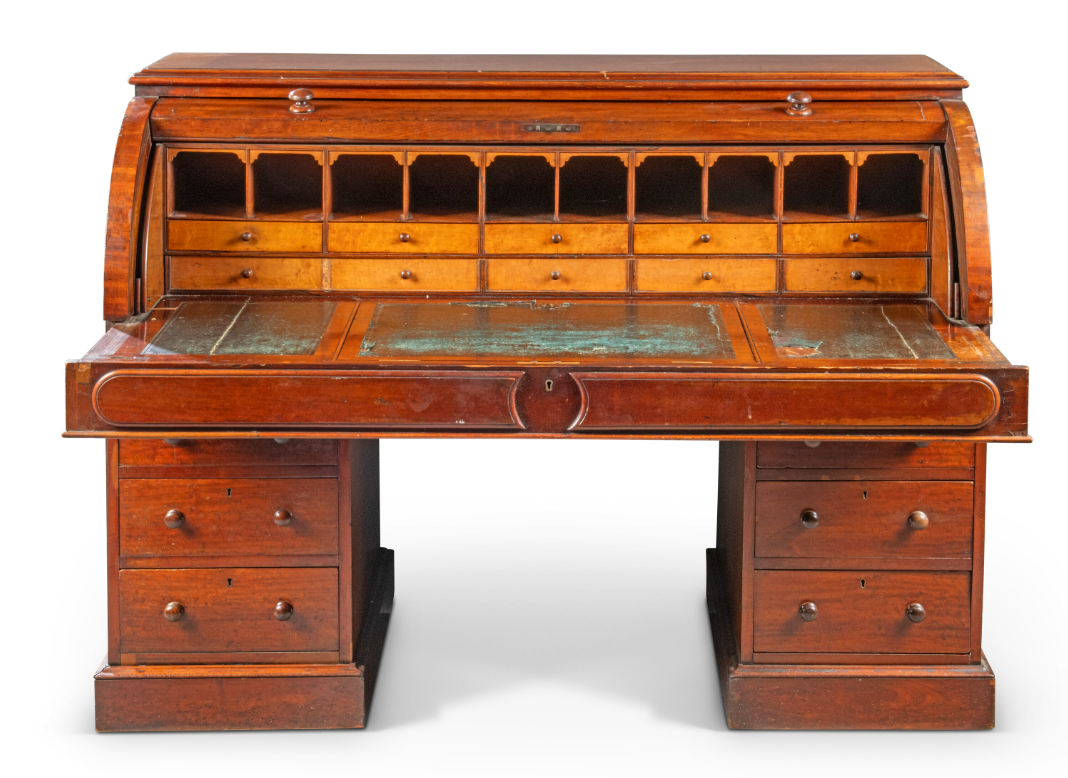
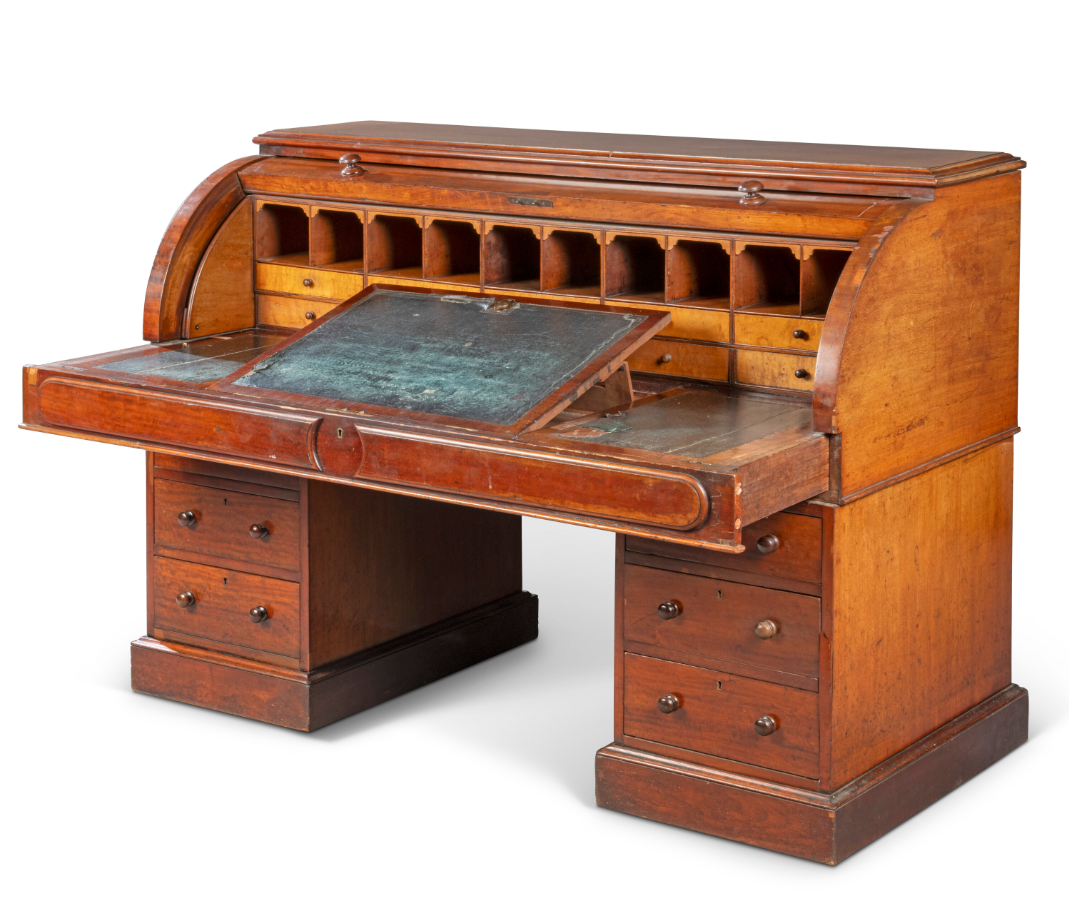
Crafted in the late 19th century, the desk itself is a mid-Victorian mahogany and satinwood rolltop pedestal model—beautiful, richly made, and full of compartments, cubbies, and drawers. But its value transcends craftsmanship. It is one of only two desks known to have belonged to Tolkien, and the only one remaining in private hands.
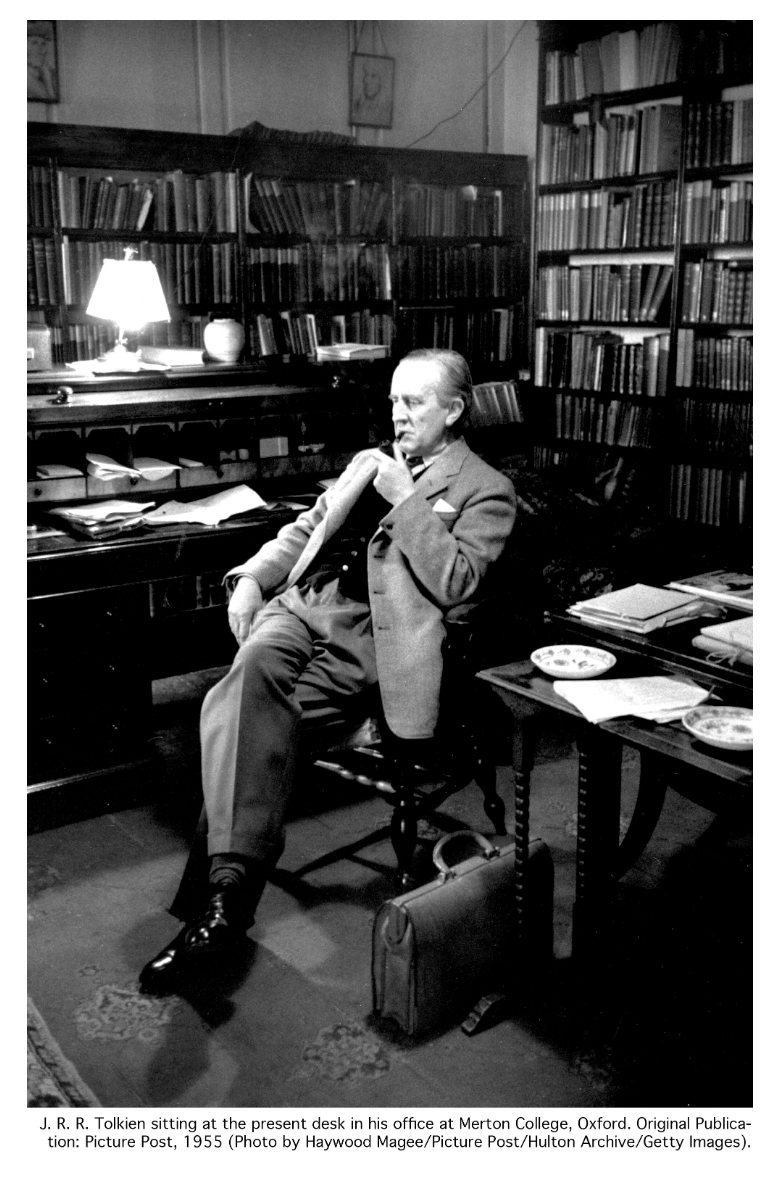
During his tenure as Merton Professor of English Language and Literature at Oxford (1945–1959), Tolkien used this desk as his primary professional workstation. Photographs from 2 December 1955, taken just weeks after The Return of the King was published, show Tolkien sitting beside the desk in his book-lined study—pipe in hand, a desk-lamp glowing above scattered manuscripts and correspondence. These images, captured by Picture Post photographer Haywood Magee, immortalize the desk at the precise moment Tolkien’s masterwork reached the world.
A Workspace of Revision, Proofs, and Creativity
Though Tolkien famously typed much of The Lord of the Rings at home “on my bed in an attic,” by the mid-1950s the Merton study had become his primary center of revision, correspondence, and scholarly work. Biographers note that it was here he managed the proofs for The Fellowship of the Ring, The Two Towers, and The Return of the King. Letters from this time, written from “the Merton Professor’s Room,” confirm that this desk was the surface on which Tolkien finalized many of the trilogy’s most important editorial decisions.
After retiring from Oxford in 1959, Tolkien moved the desk to his home at 76 Sandfield Road, Headington, where it continued to serve him through a notably productive decade. From this very piece of furniture he prepared The Adventures of Tom Bombadil (1962), Tree and Leaf (1964), Smith of Wootton Major (1967), and conducted ongoing philological research—one of his lifelong passions.
A Literary Lineage: From Tolkien to Iris Murdoch
In 1968, when Tolkien and his wife Edith relocated to Bournemouth, the desk left his possession and entered another remarkable literary household. It was purchased by Dame Iris Murdoch, the celebrated novelist and philosopher, and her husband John Bayley.
Murdoch and Tolkien shared a deep mutual admiration—beginning with what Tolkien described as a “warm fan-letter” from her in 1965. Their intellectual exchange later turned into a true friendship. Murdoch read The Lord of the Rings repeatedly and discussed it often with Tolkien or his son Christopher.
Photographs from around 1988 show Murdoch seated at this same desk, writing in her own study. A caption from Living on Paper: Letters of Iris Murdoch 1934–1995 notes:
“Sitting near the window at a roll-top desk that once belonged to J.R.R. Tolkien, she settled to write her letters.”
Thus, the desk bridged not just decades but two giants of modern British literature, a silent participant in the flow of ideas, correspondence, and creativity between them.
A Monument of Literary History
As Christie’s describes it, the desk is a material witness to Tolkien’s most public and productive years. It saw the final shaping of Middle-earth, and later, the growth of Murdoch’s own literary world. Few objects encapsulate such a direct, unbroken line between two iconic authors whose contributions helped define 20th-century literature.
Auction Details
Auction House: Christie’s
Estimate: £50,000 – £80,000
Registration Closes: December 11
Bidding Opens: December 11
For fans of Tolkien, Murdoch, or modern literature as a whole, this is a once-in-a-lifetime chance to bring home a piece of creative history.
If desks could speak, this one would tell stories of hobbits, wizards, philologists, poets, and the letters that passed between them - stories shaped in mahogany, leather, ink, and imagination.